The copper switch-off explained for London businesses and building operators | Book your free copper audit
.jpg)

Quantum computing is nearly business-ready, but is your business prepared for quantum computing?
Following the ChatGPT wave, the game-changing possibilities of AI have dominated the headlines, while quantum computing’s vast potential has largely flown under the radar.
Given that quantum algorithms—which will enable you to drive innovation, solve complex problems, and gain a competitive edge—are expected to become business accessible by 2025, quantum computing won’t stay out of the limelight for long.
Your business should expect forthcoming quantum computing opportunities; you’ll need high bandwidth internet to handle its high data demands.
What type of business internet should you look for? 10Gbps internet.
How 10Gbps prepares you for the quantum computing era

Like ‘rocket science’ and ‘astrophysics’, popular culture has transformed ‘quantum’ into a byword for distant and complicated technology.
This is misleading, as a) quantum computing is nearly here—the Boston Consulting Group believe quantum computing could be business-ready in less than two years—and b) quantum computing is quite simple for business leaders; it will increase their computing power, providing faster cloud-based connections, more efficient data transfer, greater real-time collaboration, enhanced security, and quicker data analysis.
28% of large global businesses have already set aside at least $1m for quantum computing investments, but the only way to seize ‘quantum advantage’ is by investing in high bandwidth 10Gbps internet. Here’s why.
Data transfer and synchronisation
While the computer you’re using currently processes data using binary units (either 0 or 1), a quantum computer can simultaneously process data using 0 and/or 1.
Instead of trying to figure out a 1000-path maze by testing each path until you find the right one (like a classic computer), a quantum computer can test all the paths at the same time.
As quantum computing involves manipulating and processing complex quantum information with precise synchronisation, quantum computers need fast and reliable data transfer to function. 10Gbps internet enables rapid data transfer between quantum computers, ensuring efficient synchronisation and communication.
If all that sounds like jargon to you, remember this: 10Gbps capability is crucial to executing quantum algorithms, which can solve problems that take classic computers 3,300 years in just 11 minutes.
Cloud-based quantum computing
Imagine how much your business uses the cloud today. Now consider that usage quantum-charged.
Just as today’s teams rely on cloud-based SaaS apps for day-to-day operations, tomorrow’s teams will depend on cloud-based quantum computing services to access quantum hardware and algorithms.
High bandwidth 10Gbps internet will establish a robust connection with quantum cloud platforms, enabling your teams to submit quantum jobs, transfer large datasets, and retrieve real-time computation results.
Without sufficient bandwidth, uneven access to quantum computing resources will restrain your employees’ ability to leverage quantum power. This is particularly true if you plan to use many AI-powered SaaS applications, as quantum computing will rapidly expand the possibilities of machine learning.
Collaborative research and development

Remote, real-time collaboration will be essential to maximising quantum computing’s potential.
Whether it’s your researchers and developers sharing knowledge about new quantum-enabled processes or your sales and marketing teams aligning new quantum-charged customer acquisition strategies, your business needs the ability to collaborate efficiently and effectively.
10Gbps enables seamless communication and collaboration among geographically dispersed teams working on quantum computing projects. With high bandwidth internet connectivity, researchers can exchange data, share insights, and collaborate on quantum algorithm development, which not only accelerates progress in the field but also accelerates the benefits to your bottom line.
Quantum data analysis and simulation
Let’s return to the 1,000-path maze, but think of data instead of ‘paths’.
While a classical computer will analyse the 1,000 bits of data consecutively, a quantum computer will analyse the data concurrently, vastly increasing the speed at which businesses analyse data and simulate complex scenarios.
It’s like a classic computer finding the best route for a delivery driver on Google Maps versus a quantum computer finding the best path for the whole of your supply chain, from sourcing and manufacturing to delivery and recycling.
Quantum algorithms are ideally suited for solving large-scale challenges, but only if large-scale bandwidth supports them. 10Gbps will allow you to transmit large datasets for analysis on quantum computing systems and retrieve the results efficiently, which is crucial to leveraging quantum computing insights to optimise processes and make data-driven decisions.
Quantum communication and encryption
The quantum era will usher in a complete overhaul of digital security (think how quickly a quantum computer could work out one of Google’s ‘strong’ passwords).
Businesses that have not updated their security to use quantum key distribution (QKD) protocols (quantum-generated keys designed to fend off quantum-generated attacks) will run a very high risk of cyberattack and potential data loss.
These QKD protocols are only viable if you have high bandwidth business internet, providing reliable and fast connections to support quantum communication networks.
10Gbps enables businesses to transmit and receive quantum-encrypted data, enhancing your data security and privacy in the age of increasingly sophisticated cyber threats.
Why you need 10Gbps internet to tackle quantum computing now
There’s a competitive advantage, and then there’s a quantum advantage.
According to BCG, ‘quantum computing in most industries is likely to be a winner-take-most technology, and a disproportionate share of the value created (we estimate as much as 90%) will go to early adopters.’
With quantum computing arriving sooner than you think, you must start laying the foundations today to ensure you’re part of the early adopters, not the late catcher-uppers.
At Vorboss, we provide 10Gbps connections as a minimum (with the ability to scale to 100Gbps).
While you may not develop your own in-house quantum capability—there will be the equivalent of AWS or Microsoft Azure for that—you will need the ability to run quantum computing programmes effectively.
Installing 10Gbps internet now is the first step to unleashing quantum computing’s algorithmic power and preparing your business for the future.
Book a consultation to find out why businesses are switching to Vorboss as their Internet Service Provider (ISP).

When was the last time you noticed your business internet's ability?
For most companies, a stable 1Gbps connection feels like more than enough. It handles cloud tools, video calls, and daily operations with ease.
But business doesn’t stand still. New software, higher data volumes, and AI-driven workflows are pushing connectivity demands further every year. That’s why at Vorboss, we built our network differently - giving every customer a dedicated 10Gbps connection as standard. You might not need it all today, but your future business will.
1Gbps meets today’s needs. 10Gbps powers what’s next.

1Gbps is the standard business internet in London, which is like buying an old sedan to win an F1 race. While it satisfies the most basic functions, it’s unsuited to modern demands, slow to accelerate, highly susceptible to breakdowns, and increasingly outdated with every passing month.
In short, it’s limiting your ability to drive faster and compete. Here’s why.
Impact of bandwidth on SaaS tools and team productivity
Software, data, people, and communication power modern businesses. Therefore, employee productivity is inextricably linked to internet capacity.
From Slack and Salesforce to Zoom and Zendesk, the average business uses 130 software-as-a-service (SaaS) tools for its communications, project management, accounting, and HR functionality.
Not to mention video streaming, file transfers, data analysis, and multimedia downloads. No matter your business’ core proposition, your operational efficiency relies on your business internet.
1Gbps’ low data bandwidth can slow down daily tasks, hamper productivity, and frustrate employees. With 10Gbps business internet, teams comple tasks 10X faster, and productivity (and employee morale) soar.
The business impact of high bandwidth internet is immediate and tangible. So why limit your bandwidth in the first place?
Boost remote work with high-speed business connectivity
Hybrid working is here to stay.
In June 2024, Central London workers came into the office on average 2.7 days per week, half a day longer than a year prior, with most employers supporting remote work in some capacity. And a good commercial internet connection is essential for private VPNs that allow remote users to access private company data.
Reliable online connectivity enables remote employees to access resources easily, participate in virtual collaboration effectively, and work productively. On the flip side, frequent connection drops interrupt important tasks and adversely impact customer service and employee morale.
1Gbps business internet does not provide enough reliability to banish connectivity concerns. Wouldn’t it be great if you could ensure uninterrupted connectivity for all your employees?
Prepare for the data surge: upgrade to flexible business internet

Think about how many cloud-based apps your business currently uses. Now, think about how much you will use in the near future when more game-changing AI products hit the market and quantum computing becomes the norm.
With data requirements doubling every two years, you need internet that can flexibly scale to your evolving data processing needs and easily handle more users as your business expands.
1Gbps business internet might satisfy your basic requirements today, but you need to plan for the impending surge of new data requirements to remain competitive. So why not get ahead of your rivals now instead of playing catch-up down the line?
Does bandwitdh affect customer experience?

How do you work with your clients or customers?
If your company uses real-time collaboration tools like Miro whiteboards to brainstorm ideas or Zoom conferencing services to host interactive webinars or even basic video calls, then reliable connectivity is your lifeblood; these tools don’t work if there isn’t enough bandwidth.
But, limited connectivity also impedes customers' online interaction with your business, such as unresponsive customer service or slow-to-load digital products, leading to frustrated customers, negative brand reputation, and ultimately a loss of business.
1Gbps’ limited connectivity might work now, but if you take on more customers or need to fulfil more orders, you may find yourself stuck in first gear with no way to accelerate. Why run the risk?
10Gbps = going limitless
It’s unlikely you’d accept ‘standard’ with any other part of your business, so why accept ‘standard’ with your business internet?
As technology develops, costs fall and the playing field changes. Netflix’s affordable subscription streaming made us forget about TV scheduling. Mobile network providers' unlimited packages made us forget about the cost of phone calls.
Now, 10Gbps business internet is having an effect, helping us forget about connectivity and reliability issues while making your business more productive and scalable. Businesses all across London are waking up to this, and the ship is turning. At Vorboss, we provide 10Gbps as standard (rather than the limit), as that's a sensible, technical minimum in 2023.
And, as we own the network, maintain the cables, and directly provide the customer connection, we can easily scale your data requirements as you grow, future-proofing your long-term business growth.
Without the limitations of 1Gbps, you’ll never notice your business internet again.
Book a consultation to find out why businesses are switching to Vorboss.

As technology advances, the connectivity needs of businesses change and grow. Unfortunately, other UK telecoms service providers lack the agility to adapt their services to this ever-changing landscape. They would rather keep customers in the dark about the infrastructure they are using, so they stay complacent with the status quo.
At Vorboss, we think that's wrong, so we'll dive into some of the most common myths that UK telecoms service providers perpetuate. A lack of transparency in the industry prevents businesses from getting the connectivity they deserve—connectivity that will fuel their ambitions.
Misconceptions about UK telecoms service providers
.svg)
Myth #1: Each ISP has its own fibre network
You may believe that each Internet Service Provider (ISP) has its own dedicated fibre network. In reality, most ISPs in London resell legacy Openreach infrastructure rather than relying on a network they built. This leads to unreliable connections and slow speeds for their customers.
Vorboss is the only ISP in London that has purpose-built its fibre network from scratch, using the latest technology and design. We are the only vertically integrated ISP dedicated to business in London, owning the network and service end-to-end. This gives us complete control and responsibility over our network, delivery, infrastructure, and customer experience.
Unlike other ISPs, we have no third parties involved at any stage of the process. Our in-house team handles everything from customer service, contracts, billing, installation, network design, and more. Customers deal directly with the engineers who built the network, ensuring quick response times for fault rectification, installations, and bandwidth upgrades.
Because we own the network, we can provide transparent pricing and commercial terms. There are no hidden costs or extra charges; the bandwidth you purchase is the bandwidth you receive.
Myth #2: Legacy networks are the most secure
Another misconception in the telecommunications industry is the belief that legacy networks are inherently more secure than AltNets. Telecoms companies claim that their older networks are more secure than their competitors, but the truth is that the age of a network does not determine its security level.
We understand the importance of network security at Vorboss. We designed our brand-new network with the latest security measures to ensure the highest level of protection for our customers' data.
Unlike legacy fibre networks that use on-street infrastructure, which can be vulnerable to vandalism, weather, power failures, and traffic damage, we deliver direct cable connectivity to eliminate these risks. We have diverse routing options to ensure resilience, and no one is ever more than 20 minutes away from a Vorboss engineer in Central London. We also have 24/7 proactive network monitoring and operational support from experienced network and security operations professionals.
No network is ever 100% secure, regardless of whether it's a legacy network or a newer one. Security is determined by the measures to protect the network, not by age. So, the belief that legacy networks are inherently more secure is a myth.

Myth #3: No one really needs 10Gbps bandwidth
Many mistakenly believe that businesses don't need to have 10Gbps bandwidth. Why, then, are we at Vorboss trying to make 10Gbps the new standard in speed and capacity?
For London to remain a global leader, its businesses must be future-proofed. Bandwidth consumption is constantly growing – data requirements are doubling every two years – so limited bandwidth will quickly start holding back the companies driving our city's economy. They need to be able to use emerging technologies, such as AI and quantum computing, to remain competitive.
Businesses can focus on innovation, transformation, and gaining a competitive edge by removing bandwidth concerns. We understand that some companies may not need that much bandwidth right now, but we provide it on purpose so they will never have to worry about running out in the future. Connectivity should never be a limitation for business growth.
If your business uses 1Gbps, then it uses a legacy product. The network these internet service providers use would need substantial upgrades to provide what Vorboss provides – 10Gbps as a minimum, with the capability to quickly ramp up to 100Gbps on the same network. We invested £250m into a brand-new fibre network designed for forward-thinking organisations' current and future needs.
Selling less than 10Gbps doesn't make sense to us, as it doesn't cost us any less to provide you with less bandwidth. ISPs charging incrementally for bandwidth consumption are exploiting customers to maximise profits. We don't constrain or manufacture bandwidth, and we provide purposeful abundance and transparency in pricing to our customers.
Myth #4: ISPs have the right to throttle your internet speeds
Throttling refers to ISPs temporarily slowing down your internet connection speed to manage their network capacity. This practice is often associated with wireless and mobile ISPs, but even some business fibre providers use throttling. But is that allowed?
Here's the truth – if your ISP is throttling your internet speeds, it should be outlined in your service level agreement (SLA). You have the right to be aware if you're not getting the rate you're paying for all day, every day.
It's important to note that ISPs are required to be transparent in their approach to net neutrality and traffic management. ISPs are prohibited from prioritising certain types of traffic over others and cannot intentionally slow down your connection. If you feel like throttling tactics from your current provider are holding you back, it's time to demand more or consider switching to a reliable ISP.
At Vorboss, we never throttle customer speeds, regardless of the bandwidth package customers choose. We believe in providing reliable and consistent internet speeds to our customers without sneaky tactics to hold them back. Besides, we offer Direct Internet Access (DIA), delivering connectivity to each specific customer via their own direct fibre connection. That means no varying speeds or sharing bandwidth.

Why you should demand more from UK telecoms companies
We have brought a new type of business-only internet and service to London, which is better and different from other UK telecoms companies. We want to lift the lid on industry secrets and call things out for the long-term health of our customers and the city.
We envision a future where the bandwidth for any task is available, allowing businesses to explore new solutions, ways of working, and technologies in the same way unlimited data has changed consumer behaviour with handheld devices. In turn, London will be able to compete at the highest level for years to come.
The telecommunications industry is ever-changing, and customers should always demand the best from their telecoms companies. Don't be fooled by the myths and misconceptions about them—your business deserves better.
If you want to learn more about connecting with us, speak to one of our experts today.
As technology advances, the connectivity needs of businesses change and grow. Unfortunately, other UK telecoms service providers lack the agility to adapt their services to this ever-changing landscape. They would rather keep customers in the dark about the infrastructure they are using, so they stay complacent with the status quo.
At Vorboss, we think that's wrong, so we'll dive into some of the most common myths that UK telecoms service providers perpetuate. A lack of transparency in the industry prevents businesses from getting the connectivity they deserve—connectivity that will fuel their ambitions.
Misconceptions about UK telecoms service providers
Myth #1: Each ISP has its own fibre network
You may believe that each Internet Service Provider (ISP) has its own dedicated fibre network. In reality, most business ISPs in London resell legacy Openreach infrastructure rather than relying on a network they built. This leads to unreliable connections and slow speeds for their customers.
Vorboss is the only ISP in London that has purpose-built its fibre network from scratch, using the latest technology and design. We are the only vertically integrated ISP dedicated to business in London, owning the network and service end-to-end. This gives us complete control and responsibility over our network, delivery, infrastructure, and customer experience.
Unlike other ISPs, we have no third parties involved at any stage of the process. Our in-house team handles everything from customer service, contracts, billing, installation, network design, and more. Customers deal directly with the engineers who built the network, ensuring quick response times for fault rectification, installations, and bandwidth upgrades.
Because we own the network, we can provide transparent pricing and commercial terms. There are no hidden costs or extra charges; the bandwidth you purchase is the bandwidth you receive.
Myth #2: Legacy networks are the most secure
Another misconception in the telecommunications industry is the belief that legacy networks are inherently more secure than AltNets. Telecoms companies claim that their older networks are more secure than their competitors, but the truth is that the age of a network does not determine its security level.
We understand the importance of network security at Vorboss. We designed our brand-new network with the latest security measures to ensure the highest level of protection for our customers' data.
Unlike legacy fibre networks that use on-street infrastructure, which can be vulnerable to vandalism, weather, power failures, and traffic damage, we deliver direct cable connectivity to eliminate these risks. We have diverse routing options to ensure resilience, and no one is ever more than 20 minutes away from a Vorboss engineer in Central London. We also have 24/7 proactive network monitoring and operational support from experienced network and security operations professionals.
No network is ever 100% secure, regardless of whether it's a legacy network or a newer one. Security is determined by the measures to protect the network, not by age. So, the belief that legacy networks are inherently more secure is a myth.
Myth #3: No one really needs 10Gbps bandwidth
Many mistakenly believe that businesses don't need to have 10Gbps business internet bandwidth. Why, then, are we at Vorboss trying to make 10Gbps the new standard in speed and capacity?
For London to remain a global leader, its businesses must be future-proofed. Bandwidth consumption is constantly growing – data requirements are doubling every two years – so limited bandwidth will quickly start holding back the companies driving our city's economy. They need to be able to use emerging technologies, such as AI and quantum computing, to remain competitive.
Businesses can focus on innovation, transformation, and gaining a competitive edge by removing bandwidth concerns. We understand that some companies may not need that much bandwidth right now, but we provide it on purpose so they will never have to worry about running out in the future. Connectivity should never be a limitation for business growth.
If your business uses 1Gbps, then it uses a legacy product. The network these internet service providers use would need substantial upgrades to provide what Vorboss provides – 10Gbps as a minimum, with the capability to quickly ramp up to 100Gbps business internet on the same network. We invested £250m into a brand-new fibre network designed for forward-thinking organisations' current and future needs.
Selling less than 10Gbps doesn't make sense to us, as it doesn't cost us any less to provide you with less bandwidth. ISPs charging incrementally for bandwidth consumption are exploiting customers to maximise profits. We don't constrain or manufacture bandwidth, and we provide purposeful abundance and transparency in pricing to our customers.
Myth #4: ISPs have the right to throttle your internet speeds
Throttling refers to ISPs temporarily slowing down your internet connection speed to manage their network capacity. This practice is often associated with wireless and mobile ISPs, but even some business fibre providers use throttling. But is that allowed?
Here's the truth – if your ISP is throttling your internet speeds, it should be outlined in your service level agreement (SLA). You have the right to be aware if you're not getting the rate you're paying for all day, every day.
It's important to note that ISPs are required to be transparent in their approach to net neutrality and traffic management. ISPs are prohibited from prioritising certain types of traffic over others and cannot intentionally slow down your connection. If you feel like throttling tactics from your current provider are holding you back, it's time to demand more or consider switching to a reliable ISP.
At Vorboss, we never throttle customer speeds, regardless of the bandwidth package customers choose. We believe in providing reliable and consistent internet speeds to our customers without sneaky tactics to hold them back. Besides, we offer Direct Internet Access (DIA), delivering connectivity to each specific customer via their own direct fibre connection. That means no varying speeds or sharing bandwidth.
Why you should demand more from UK telecoms companies
We have brought a new type of business-only internet and service to London, which is better and different from other UK telecoms companies. We want to lift the lid on industry secrets and call things out for the long-term health of our customers and the city.
We envision a future where the bandwidth for any task is available, allowing businesses to explore new solutions, ways of working, and technologies in the same way unlimited data has changed consumer behaviour with handheld devices. In turn, London will be able to compete at the highest level for years to come.
The telecommunications industry is ever-changing, and customers should always demand the best from their telecoms companies. Don't be fooled by the myths and misconceptions about them—your business deserves better.
If you want to learn more about connecting with us, speak to one of our experts today.

The gender pay gap is the difference between the average earnings of women and men across a workforce at a single point in time, expressed as a percentage of men’s earnings. It is not the same as equal pay, which refers to paying women and men the same wage for the same job.
Vorboss gender pay gap
The Vorboss gender pay gap report shows that we are making significant strides towards reducing the gender pay gap and increasing diversity within our workforce. In 2022, Vorboss had a -5.6% median gender pay gap, compared to the UK median gender pay gap of 9.4%.
We’re proud that the report highlights our commitment to equity, inclusion, and diversity in all business areas. We have implemented policies that encourage women to join and stay in our workforce. We have focused on improving diversity within our field-based roles, which are historically male-dominated within the industry.
Our CEO, Tim Creswick, comments, 'We grew our team dramatically during the period, yet I'm pleased to report that we seized the opportunity to do so inclusively. While we still have a lot more we want to do, I'm proud to report sector-leading gender diversity. Whilst the pay gap figures required by law don't show the full picture, we've worked hard to ensure women are on an absolutely equal footing in our organisation.'
It is important to mention that our 2023 data will reflect our emphasis on improving diversity in lower and middle roles. We need to focus on hiring and progressing more women into leadership roles. Although our report is very positive for 2022, we acknowledge that work is still to be done.
You can read the full 2022 gender pay gap report here.

This blog is part of a series of techUK interviews platforming inspiring women in tech. The series aims to call out gender bias, expose industry barriers, and spotlight the importance of a diverse tech future.
Women make up almost 40% of the build and installations team at Vorboss, so they are undoubtedly an influential part of the company. Their successes highlight the possibilities that arise when telecoms companies create inclusive, gender-balanced workplaces.
This is an interview of Caprice and Acacia, two of our inspiring Vorboss installation technicians. They serve as fantastic examples of flourishing women in tech.
Women in tech: interview with installation technicians Caprice and Acacia
Were you always interested in the telecoms industry, or were you drawn in by Vorboss and the diversity they offer?
Caprice: I’d say both to be honest. I like doing jobs where I’m busy and get to use my brain. This job was perfect, as I liked that there were good opportunities for women, and it’s something that I’m genuinely interested in. Before I started, I didn’t even know what chambers were (the covers you see on pavements where fibre cables are stored). Now I’m able to tell my grandparents about what they are and what they’re for, which is cool.
Acacia: I think having diverse teams is incredibly important, as you get more variety of views and people have different ideas and experiences. There’s always been another woman on my team with me at Vorboss, which is nice.
When did you join Vorboss? Can you give us an insight into your day-to-day job?
Caprice: I started in September. I work Tuesdays to Fridays in the field. Sometimes we could be blowing fibre through a subduct, other days we could be rodding and roping a route. Every day is different; it’s never the same, but it’s always exciting, and I’m always happy to go to work.
As this was your first job in telecoms, was training available to you?
Caprice: There was lots of training. There were also lots of people on standby to support me if I needed anything. I joined the Vorboss Academy—an accredited in-house training programme—which was eight weeks long. Some of it was online training, but I also went to the warehouse training centre every day and learned things like how to safely lift chamber lids and how to splice.
Why do you think that there are more men working in this sector than women?
Acacia: As it’s quite a physical job, traditionally people probably viewed it as more suited to men. Times have changed and women can now have a career in something that they feel suits them.
Do you feel Vorboss creates a supportive environment for women?
Caprice: Yes, definitely. For example, if there is a really heavy chamber lid, women can do it together. Women can work together on things like that. Also, they have made sure that the uniform fits for everyone. There is a uniform for women, but if women also want to wear the menswear to suit their personal preference, they can choose that also.
Acacia: We have support like period days. It’s a great help, especially as you can’t avoid having symptoms. We also have events such as women’s movie nights and women’s breakfasts where we all come together to talk about issues that we’re going through and how to make the workplace more inclusive for women. It definitely feels like a safe space to talk about things and helps to build a nice company culture.
Looking around at the people you work with, do you feel that it’s a diverse group?
Caprice: Yes, I would say so. In my team, there are actually more women than men. It’s nice to work with other women, and it feels more equal. I don’t feel belittled, and it shows that women can do a job which traditionally has been thought of as a man’s job. We get a lot of comments from pedestrians going past saying it’s nice to see women doing this job.
Acacia: It’s nice to see that a company in the industry is supporting women, and it’s inspirational for women working at Vorboss to see that they are trying to make a change. It shows that women of all ages can work as part of the installation teams, and it’s not just a role for men. Anyone can do it once they’re trained.
What sort of challenges have you faced in your role?
Acacia: There have been times where pedestrians walk past saying this isn’t a woman’s job. I don’t get that as much anymore. Vorboss is trying to encourage more women to work in the industry, and it’s becoming more normal. When things like that happen, we can go straight to our manager and are given support to make sure that we feel comfortable going to work every day. As Caprice said, there are also a lot more positive interactions with the public where we are recognised for having such a diverse team.
What’s your number one piece of advice for the future generations entering tech?
Acacia: Just go for it! If the opportunity comes up, take it with both hands and try to shine. You can learn so much!
Caprice: I’d say the same. Don’t let anything stop you or get in your way! You never know unless you try. Believe in yourself and don’t have self-doubt! Gender shouldn’t matter. There’s an opportunity for everyone.
Our people and culture team always puts equity, inclusion, and diversity first. If the Vorboss culture sounds right to you, head to our careers page to see our vacancies!
Latest from the press room


The experience driving our growth
David has been central to our success as our Chief Financial Officer. Drawing on his experience at Zayo Group and RBC Capital Markets, he brings strong insight across large-scale infrastructure, investment banking and managed services. As our CFO, he’s been instrumental in shaping a commercial model that supports businesses as they grow, giving our customers the certainty and simplicity they expect.
Rhod has played a pivotal role in operations at Vorboss since 2020. He led the build of our network, now spanning over 900 km, and has raised industry standards across quality and efficiency, making sure our customers have a flawless experience. With previous roles at companies like Arup and WeWork, Rhod understands the complexity of London commercial real estate and knows exactly what it takes to deliver world-class technology in a fast-paced city.
The next chapter
Under David and Rhod’s leadership, we are doubling down on our commitment to keep things simple for our customers and remain the transparent, accountable provider ambitious businesses rely on as they grow.
“Vorboss is on path to becoming one of the UK’s leading B2B connectivity and managed service providers,”
says Adam Dunlop, Operating Partner at Octopus Capital and Chair of the Vorboss Board.
“With David and Rhod’s leadership, and the strength and commitment of the team across the business, I am genuinely excited about what lies ahead.”
Vorboss is part of the Fern Trading Group, managed and advised by Octopus Investments. This partnership, backed by £250million in funding, enabled us to build an independent, 100Gbps London fibre network and connect thousands of businesses across the capital. Having expanded our offering with a range of cybersecurity and managed technology solutions last year, we continue to do things differently by delivering everything end-to-end through our in-house teams.
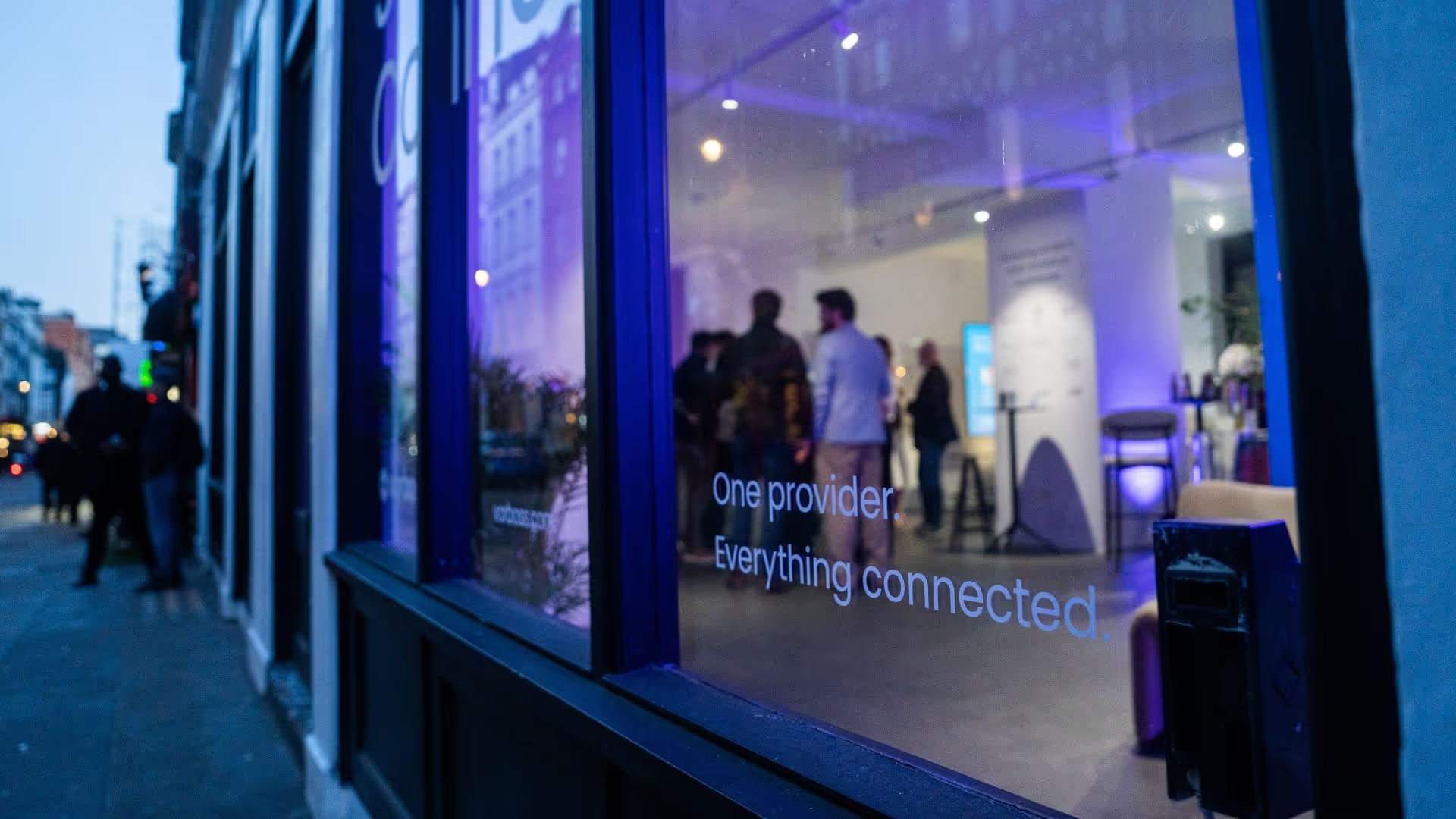

As companies grow, so does the technology behind them. Connectivity, IT and cybersecurity often end up spread across multiple suppliers, contracts and support models. Simply Connected brings it all together under one provider, making it easier to manage, easier to support, and clearer to understand costs.
At the heart of it is Vorboss’ own fibre network spanning over 750km across London, built, owned and operated in-house, with the same team designing, installing and managing the full setup end-to-end.
“Office technology has become overcomplicated,”
said Rhod Morgan, Chief Operations Officer at Vorboss.
“Many businesses have the right services on paper, but the experience feels disjointed. We wanted to remove the grey areas. Customers manage one relationship, have access to local support and receive one predictable monthly bill. The same team that builds the solution runs and supports it day-to-day.”
Simply Connected includes modular services that flex around each business and scale as it grows:
- Dedicated internet connectivity from Vorboss
- Fully managed office networks
- Managed IT and hardware provisioning
- Cybersecurity
- Ongoing support delivered by local London experts